Intuitive product select
Case Study
Client identity, proprietary content, and interface details have been generalized. Visuals shown here are representative reconstructions of the design process and experience.
Role Product Designer
Context Client facing JO project
Year 2026
I conducted a usability study with 10 participants, asking each to navigate the existing product select experience. Sessions were screen and audio recorded through Userlytics, allowing me to analyze participant behavior, responses, and decision-making throughout the journey.
Too many choices. Not enough confidence.
Observed behavior
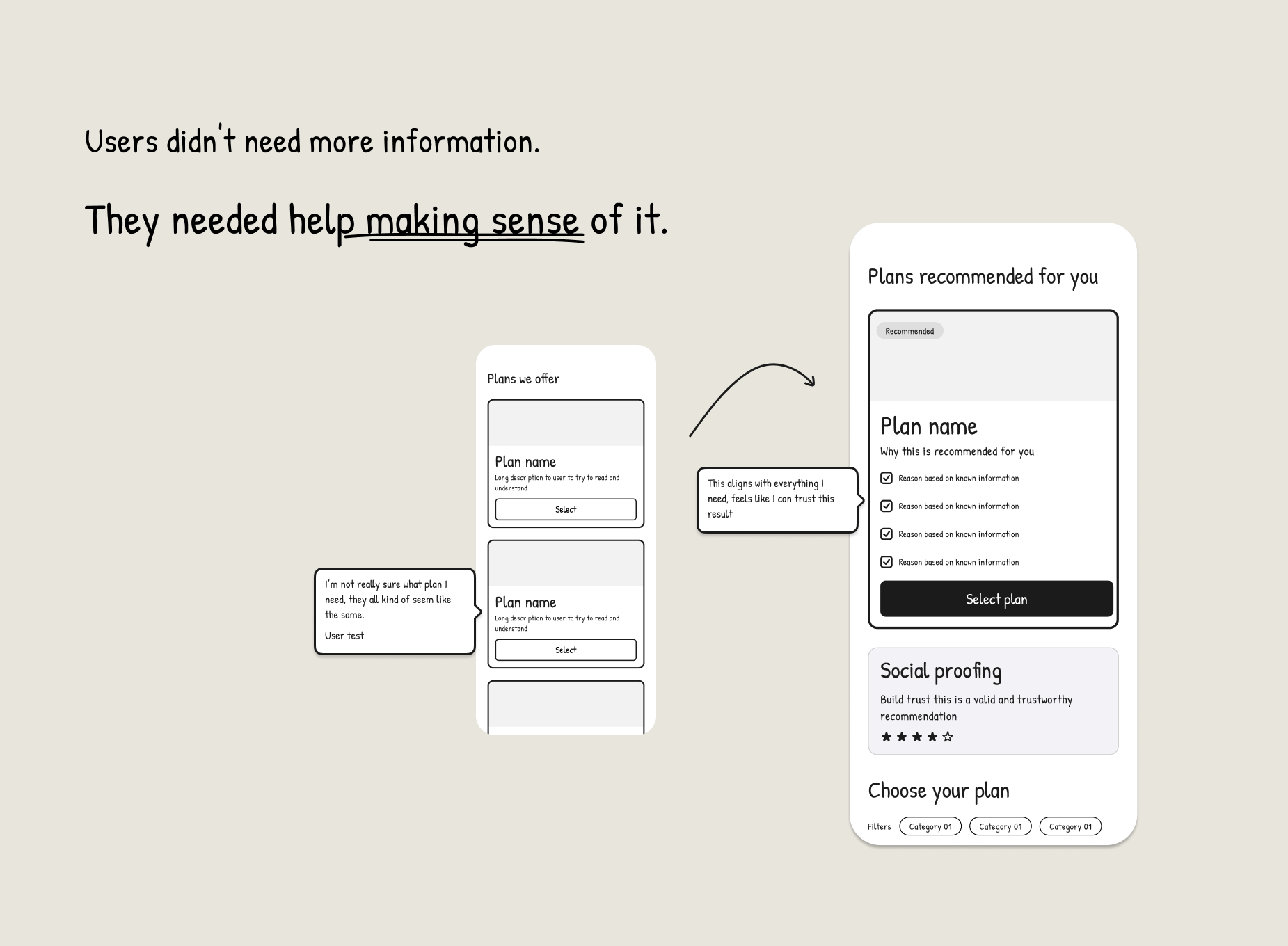
Plan differences were unclear.
Participants often struggled to understand what differentiated one plan from another.
Comparison wasn't intuitive.
Participants narrowed their choices to one or two options, but frequently relied on repeated scrolling and manual comparison to do so.
The final decision still felt uncertain.
Even after narrowing their options, participants lacked confidence that they had identified the best fit.
Users can make their own decision but the experience was asking them to do too much of the work themselves, resulting in site drop offs for users to do their own learning and discovery.
Uncovering the problem
The friction wasn't finding a plan.
It was feeling confident choosing one.
The study revealed a familiar decision-making pattern, when users are faced with too many similar options, they begin narrowing the field themselves. This practice causes them to rely on repeated comparison to reduce the number of choices. Instead of helping users make that decision, the experience placed the burden on them to interpret, compare, and ultimately validate their own choice.
Users are stuck in a never ending cycle of too much cognitive load

What if the experience did more of the work?
Taking the experience from comparing everything to understanding what matters.
The research showed that users could narrow their choices, but they were doing much of that work themselves. We saw an opportunity to turn that manual comparison into a lightweight, personalized recommendation experience that could simplify the decision without taking control away from the user.
A few meaningful questions could identify what mattered most to each user, narrow the available options, and surface a recommendation with enough context to make the choice feel relevant and trustworthy.
From comparison to guidance.
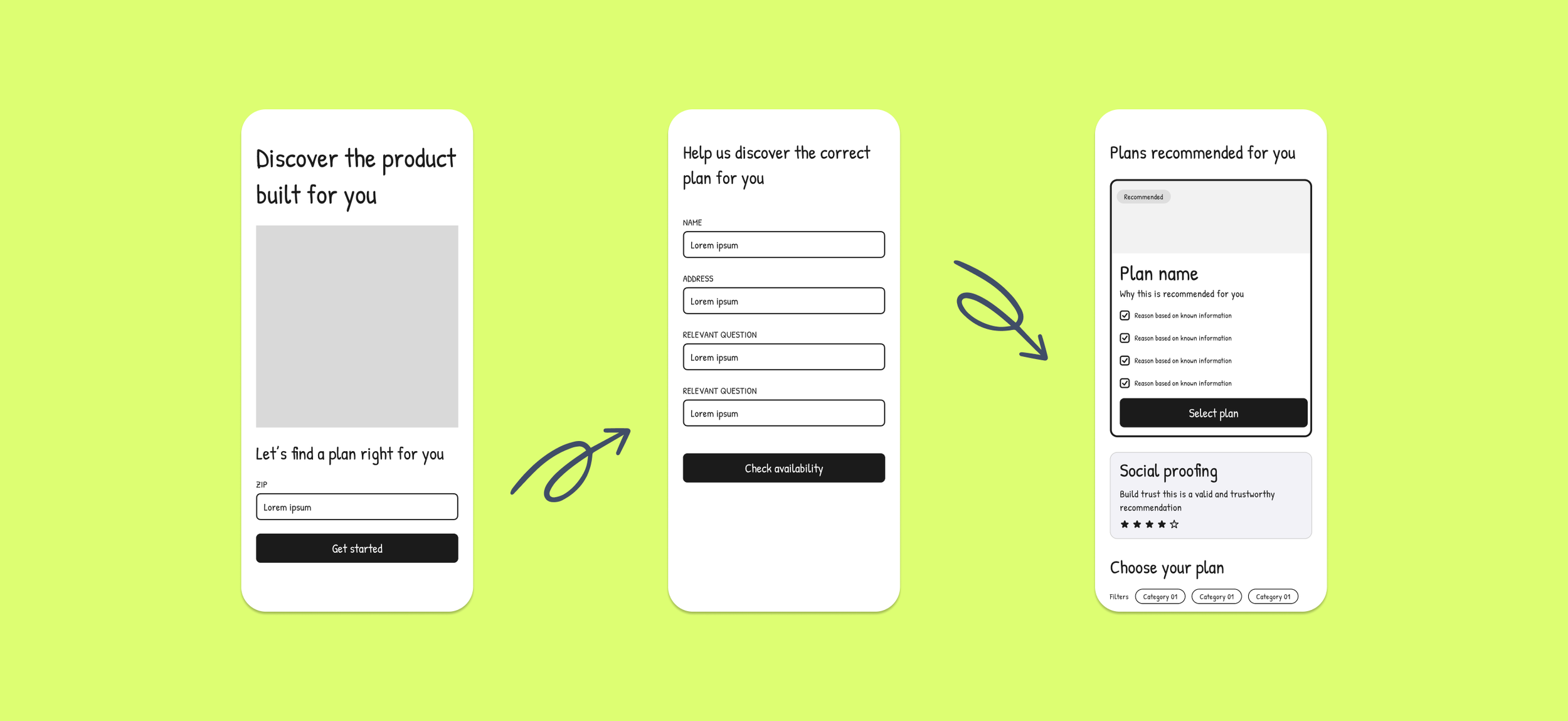
Learn more about you
A small set of questions captures the preferences that matter most.
Narrow the field
Responses reduce an overwhelming set of options to a manageable few.
Recommend
The experience identifies a strong-fit option based on those preferences.
Build confidence
The recommendation explains why it fits, giving the user a reason to trust the result.
A better way to make the decision.
A better way to make the decision.
A better way to make the decision. A better way to make the decision.
A better way to make the decision.
The final experience transformed plan selection from a manual comparison process into a guided, personalized journey. By asking users a small set of targeted questions, the experience narrowed a complex set of options into a recommendation that felt relevant while still giving users enough context to understand and trust their choice.
Designed to move users forward.
The experience launched as a new path through plan selection and delivered stronger performance while reducing drop-off throughout the journey. The result reinforced the value of reducing cognitive load, not by removing choice, but by helping users navigate it with greater clarity and confidence.